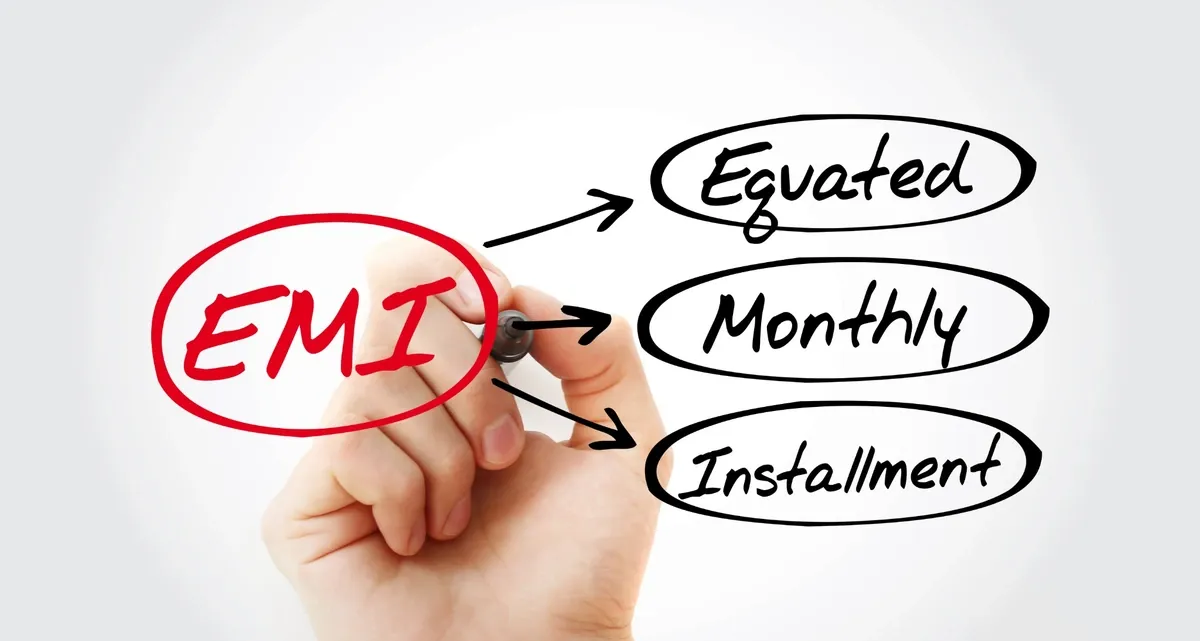
What is EMI and How is it Calculated?
January 18, 2025

Imagine standing at the showroom, eyeing the latest scooter or a brand-new car. The excitement is real, but so is the hefty price tag. Paying the full amount upfront feels overwhelming, but there's a solution that bridges the gap between desire and affordability—Equated Monthly Instalments (EMIs). This financial tool has empowered millions of Indians to own their dream vehicles, homes, and gadgets without straining their savings.
According to the Reserve Bank of India (RBI), household credit in India surged by 17% year-on-year in 2024, driven largely by consumer loans for vehicles, homes, and personal needs. With rising aspirations and easy access to credit, EMIs have become an essential part of everyday financial planning.
What is EMI Full Form and Meaning?
EMI stands for Equated Monthly Instalment. Let’s say you have taken a home loan of ₹10 lakh for a tenure of 10 years. You have to repay the amount to the bank in EMIs, meaning every month a fixed amount would be deducted from your linked bank account until the loan is fully repaid. Each EMI consists of two components:
- Principal Amount: The original loan amount.
- Interest Amount: The cost charged by the lender for borrowing the money.
Over the loan tenure, the interest portion decreases while the principal repayment increases. This structure is known as the reducing balance method, which is widely used for most loans in India. EMIs offer a predictable repayment structure, helping you manage large expenses—such as buying a home, bike, card, or even funding education—without depleting your savings.
How is Loan EMI Calculated?
EMI is calculated based on the loan amount, interest rate, and tenure. Adjusting these parameters would either reduce or increase your loan EMI. Please note that the loan processing fee is not a part of your EMI.
Banks and financial institutions calculate interest on loans using three common methods: daily reducing balance, monthly reducing balance, and annual reducing balance. Each method impacts how quickly the loan principal reduces, influencing the total interest paid over the loan tenure.
1. Daily Reducing Balance Method (Most Efficient for Borrowers)
In the daily reducing balance method, the outstanding loan principal decreases daily as you make payments. Interest is calculated on the remaining principal every day, making this method highly borrower-friendly, especially for large loans like home loans.
How It Works:
- When you pay your EMI, the principal reduces immediately.
- Any partial prepayments made during the month instantly lower the outstanding principal, leading to lower interest charges for the remaining loan.
Example:
- If your EMI is due on the 5th of every month and you make a prepayment on the 10th, the principal reduces on the 10th itself.
- As a result, from the 10th onward, interest is charged on the lower principal, saving you money.
This method is widely used by banks for home loans and large personal loans, as it minimizes the overall interest burden.
2. Monthly Reducing Balance Method
In the monthly reducing balance method, the principal is reduced once a month, after the EMI is paid.
Example:
- If you make a prepayment on the 10th, it won’t reflect until the next EMI date (e.g., the 5th of the following month).
- This delay results in slightly higher interest payments compared to the daily reducing method.
Housing finance companies often use this method, but it is less efficient than the daily reducing balance method.
3. Annual Reducing Balance Method
In the annual reducing balance method, the principal reduces only once a year, after EMI payments for the entire year.
This outdated method results in significantly higher interest payments and is rarely used today.
What is Loan Amortization Schedule?
A loan amortization schedule details how each EMI is split between principal and interest, along with the outstanding principal after every payment. It helps you track your repayment progress over the loan tenure.
Loan EMI Calculation Formula
The formula to calculate EMI is: EMI=(1+R)N−1P×R×(1+R)N
Where:
- P = Loan principal
- R = Monthly interest rate (annual rate/12)
- N = Total number of monthly instalments
For example, a ₹50 lakh loan at a 10% interest rate over 20 years results in an EMI of approximately ₹48,251.
This structured repayment helps borrowers manage large loans effectively while minimizing interest through methods like the daily reducing balance. However, manual calculations can be taxing and may leave room for errors. As a better alternative, use our Home Loan EMI Calculator. Ujjivan’s EMI Calculator is extremely easy to use. All you need to do is select the loan amount, tenure and applicable interest rate. The EMI Calculator would show your EMI amount. You can also separately check the principal and interest amount.
Can You Increase Your EMI After Taking a Loan?
You can increase your EMI or reduce the loan tenure by writing to the bank. You may require a few documents (generally forms) to submit, including your desired loan tenure or EMI amount. Increasing your EMI or lowering your loan tenure can help you reduce the interest component, lower the total cost of the loan and close your loan faster.
| Loan Amount | Tenure | Interest Rate | EMI | Total Interest Paid |
| ₹10 lakh | 15 years | 8.75% p.a. | ₹9,934 | ₹7,99,007 |
| ₹10 lakh | 10 years | 8.75% p.a. | ₹12,532 | ₹5,03,921 |
As you can see, though the EMI is higher, you would end up saving approximately ₹3 lakh on interest.
Nothing contained herein is intended to constitute financial, investment, legal, tax, or any other professional advice or opinion. Please obtain professional advice before making investment or any other decisions. Any investment decisions that may be made by the you shall be at your own sole discretion, independent analysis and evaluation of the risks involved. The use of any information set out in this document is entirely at the user’s own risk. Ujjivan Small Finance Bank Limited makes no representation or warranty, express or implied, as to the accuracy and completeness for any information herein. The Bank disclaims any and all liability for any loss or damage (direct, indirect, consequential, or otherwise) incurred by you due to use of or due to investment, product application decisions made by you on the basis of the contents herein. While the information is prepared in good faith from sources deemed reliable (including public sources), the Bank disclaims any liability with respect to accuracy of information or any error or omission or any loss or damage incurred by anyone in reliance on the contents herein, in any manner whatsoever.
To know more about Ujjivan Small Finance Bank Products Visit:"https://www.ujjivansfb.bank.in"
All intellectual property rights, including copyrights, trademarks, and other proprietary rights, pertaining to the content and materials displayed herein, belong
to Ujjivan Small Finance Bank Limited or its licensors. Unauthorised use or misuse of any intellectual property, or other content displayed herein is strictly prohibited and the same is not intended for distribution to, or use by, any person in any jurisdiction where such distribution or use would (by reason of that person’s nationality, residence or otherwise) be contrary to law or registration or would subject Ujjivan Small Finance Bank Limited or its affiliates to any licensing or registration requirements.